Drew O’Neil discusses fixed income market conditions and offers insight for bond investors.
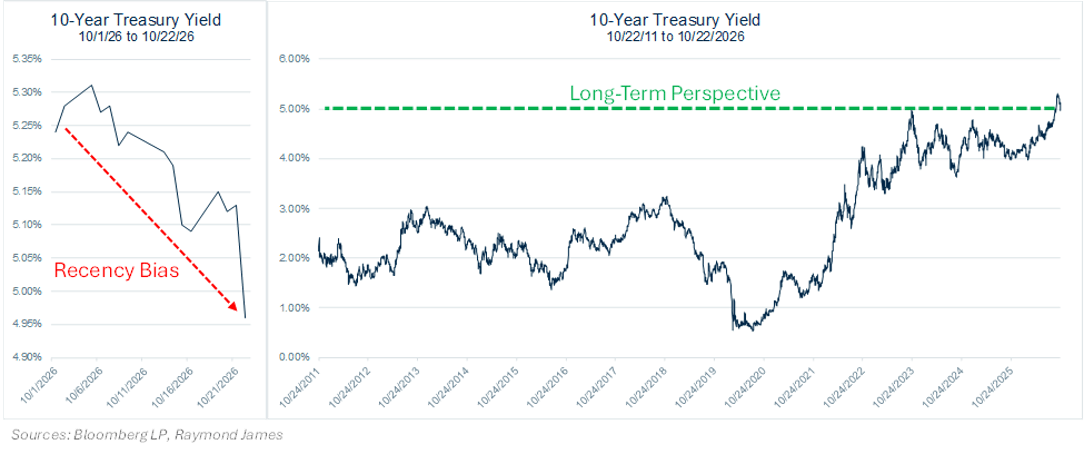
The human brain has a remarkable ability to adjust what it considers to be normal, oftentimes very quickly. Experiencing or achieving something that might have previously seemed like a long shot can quickly shift our mindset to expect that outcome over and over again. While yields have been very attractive for the past few years compared to the past several decades, we recently experienced a spike even higher across a range of fixed income products. This presented opportunities that had not been readily available for 15+ years. The 10-year Treasury yield pushed over 5.30% for the first time since 2002 and the 30-year AAA municipal yield touched over 5% for the first time since 2011. For many investors, reaching levels that haven’t been attained in 15+ years for just a few days quickly entrenched them as normal. This is a form of recency bias that can potentially have negative long-term influences when it affects investment decisions.
When recency bias paints what might be a once-in-a-decade opportunity as normal in our brains, it can cause hesitation when considering making an investment. In reality, when viewed in the context of years or decades and not days or weeks, the opportunity at hand is still tremendous. Yields have pulled back from their peaks of late-September but relative to most points over the past several decades, they still present a good opportunity for investors to lock in attractive yields for a long period of time, in turn solidifying the fixed income portion of their portfolio for years to come. It is all about the lens from which you are viewing things.
Yes, yields a few weeks ago were higher than they are right now. That does not mean that yields are destined to return to those levels. Could they? Absolutely, but they could also remain where they are or continue to move lower from here. Attempting to time the market is generally not going to pay off in the long run for fixed income investments. A more useful decision-making process when choosing whether or not to make an investment is to look at the opportunities that are currently available and decide if the yields that can be locked in today align with your long-term financial plan. If the answer is yes, which there is a good chance that they do, then now might be a good time to pull the trigger. Historically, when yields have seen sharp increases like we have seen over the past few months, the window of opportunity did not last long. Now is a good time to have a discussion with your financial advisor about whether locking in yields at current levels aligns with your long-term financial plan.
The author of this material is a Trader in the Fixed Income Department of Raymond James & Associates (RJA), and is not an Analyst. Any opinions expressed may differ from opinions expressed by other departments of RJA, including our Equity Research Department, and are subject to change without notice. The data and information contained herein was obtained from sources considered to be reliable, but RJA does not guarantee its accuracy and/or completeness. Neither the information nor any opinions expressed constitute a solicitation for the purchase or sale of any security referred to herein. This material may include analysis of sectors, securities and/or derivatives that RJA may have positions, long or short, held proprietarily. RJA or its affiliates may execute transactions which may not be consistent with the report’s conclusions. RJA may also have performed investment banking services for the issuers of such securities. Investors should discuss the risks inherent in bonds with their Raymond James Financial Advisor. Risks include, but are not limited to, changes in interest rates, liquidity, credit quality, volatility, and duration. Past performance is no assurance of future results.
Investment products are: not deposits, not FDIC/NCUA insured, not insured by any government agency, not bank guaranteed, subject to risk and may lose value.
To learn more about the risks and rewards of investing in fixed income, access the Financial Industry Regulatory Authority’s website at finra.org/investors/learn-to-invest/types-investments/bonds and the Municipal Securities Rulemaking Board’s (MSRB) Electronic Municipal Market Access System (EMMA) at emma.msrb.org.