Drew O’Neil discusses fixed income market conditions and offers insight for bond investors.
The FOMC left the Fed Funds rate unchanged at their meeting last week, as expected. While the Committee did not make any policy changes, the interest rate market was quite active. There was a strong bear-steeping of the Treasury curve on Wednesday afternoon as the 2-year yield fell by around 10 basis points while the 30-year yield rose by about the same margin. This was seemingly a reaction to Chair Warsh providing very little clarity on when and if the FOMC might take action on the fight against inflation. Warsh reiterated that 2% remained the inflation target and the Committee was committed to achieving that goal but provided mostly vague answers to the string of questions he received at the press conference. The drop in yields on the short end of the curve is an indication that market participants have less conviction about potential future Fed Funds rate increases. The rise in longer maturity yields points to uneasiness about how a Warsh-led Fed is going to operate and if/when they are going to take action in the face of inflation that remains well above their stated target. Ongoing geopolitical tensions, higher oil prices, concern over future US Treasury borrowing, and a surge in AI-related borrowing to fund capital expenditures are all weighing on long-term yields.
What’s the takeaway for fixed income investors? Higher yields are an opportunity to purchase bonds that provide higher levels of income. Yields are higher across the fixed income universe over the past month. While many of the headlines and commentaries that investors have probably read recently focus on the move lower in bond prices, buyers of individual bonds need to remember to flip that statement upside down. In the world of packaged products that focus on total return, negative price movement is seen as just that: a negative. This makes sense for investment vehicles that have no stated maturity date and value. Returns for investors in these vehicles are largely affected by the change in price between their entry and exit points. For investors who utilize individual bonds instead of packaged products, the “dip” in price that packaged product investors might focus on is an opportunity to buy higher yielding bonds.
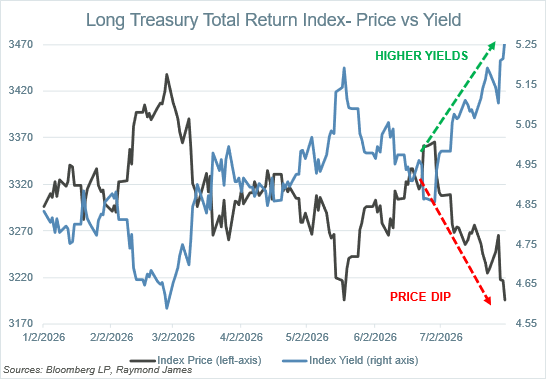
When you own bonds, the maturity date, maturity value, income earned, and stream of cash flow are all locked in at the time of purchase (barring a default) and unaffected by price changes. Despite gloomy headlines, the drop in prices and negative performance in fixed income means that yields have moved higher and present an opportunity for fixed income investors to enter the market at more attractive levels. Yields are higher across the curve but the moves have been notably larger on the intermediate and long part of the curve. Notably, the 30-year Treasury yield touched 5.24% last week, marking its highest level since 2007. To provide a visual, the graph below charts both the price and yield of the Bloomberg Long Treasury Total Return Index year-to-date. This highlights the difference in perspective between total-return focused investors who might be more concerned with price movement versus buy-and-hold fixed income investors who own individual bonds. Individual bond investors understand that the negative interim price movement has no negative effect on their returns while recognizing that higher yields provide a more attractive entry-point for putting new money to work.
In July, Treasury yields were higher by 6 to 8 basis points on the short end of the curve while increasing by 23 to 29 basis points on the intermediate to long part of the curve. As noted above, the 30-year yield reached its highest level in nearly two decades. Investment-grade corporate yields saw similar moves as spreads ended the month within a few basis points of where they started at the index level. Municipal yields pushed higher by slightly larger margins than their taxable counterparts. The AAA municipal curve was higher by 20 to 43 basis points which translates to taxable-equivalent yield increases of 35 to 73 basis points for investors in the top federal tax bracket (37% Federal + 3.8% NIIT). Given the high levels of political and economic uncertainty around the globe, whether we stay at these attractive yield levels for an extended period or soon retreat to a lower-yielding environment is difficult to predict. For investors with money to put to work, the recent move to higher yields could be a good opportunity to take advantage of attractive income opportunities that have seldom been available over the past two decades.
The author of this material is a Trader in the Fixed Income Department of Raymond James & Associates (RJA), and is not an Analyst. Any opinions expressed may differ from opinions expressed by other departments of RJA, including our Equity Research Department, and are subject to change without notice. The data and information contained herein was obtained from sources considered to be reliable, but RJA does not guarantee its accuracy and/or completeness. Neither the information nor any opinions expressed constitute a solicitation for the purchase or sale of any security referred to herein. This material may include analysis of sectors, securities and/or derivatives that RJA may have positions, long or short, held proprietarily. RJA or its affiliates may execute transactions which may not be consistent with the report’s conclusions. RJA may also have performed investment banking services for the issuers of such securities. Investors should discuss the risks inherent in bonds with their Raymond James Financial Advisor. Risks include, but are not limited to, changes in interest rates, liquidity, credit quality, volatility, and duration. Past performance is no assurance of future results.
Investment products are: not deposits, not FDIC/NCUA insured, not insured by any government agency, not bank guaranteed, subject to risk and may lose value.
To learn more about the risks and rewards of investing in fixed income, access the Financial Industry Regulatory Authority’s website at finra.org/investors/learn-to-invest/types-investments/bonds and the Municipal Securities Rulemaking Board’s (MSRB) Electronic Municipal Market Access System (EMMA) at emma.msrb.org.